Some things inside the human body happen so naturally—like breathing—that we overlook them entirely.
One of those overlooked truths is the tight connection between the Lungs (Phế) and the Large Intestine (Đại tràng).
At first glance, it seems simple:
Nothing seems related.
Yet in Traditional Chinese Medicine (TCM), the Lungs and the Large Intestine are considered a paired system, belonging to the Metal element, forming a Biao–Li (Exterior–Interior) relationship.
Even more surprising is a principle many people “know of” — but rarely understand clearly:
The expulsion of stool is not solely the work of the Large Intestine —
it also depends on the descending action of Lung Qi (Phế khí túc giáng).
In other words: your Lungs contribute to your bowel movement every single day.
Even people who have studied TCM for years often memorize the statement:
“The Large Intestine expels stool with the assistance of Lung Qi descending.”
But how it works, and why, remains unclear to many.
Today, we will break down this relationship — deeply, clearly, and logically — to see how the most obvious truths are sometimes the most forgotten.
In TCM, the Lungs perform two classic functions:
If Lung Qi descends smoothly:
If descending is impaired:

The Large Intestine:
But the Large Intestine is a Fu organ — it does not generate its own Qi, nor can it create propulsion on its own.
To expel waste, it needs Qi.
And the organ that governs Qi movement in the body is the Lungs.
Hence the classical statement:
“When Lung Qi flows freely, bowel movements are easy.
When Lung Qi is constrained or deficient, constipation occurs.”
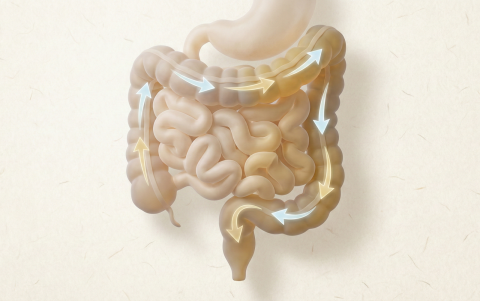
The Large Intestine is like a pipe.
The Lungs are the air pump that drives movement inside that pipe.
The deeper we examine modern physiology, the more we realize:
The ancients described it correctly — only the vocabulary differs.
After food is digested in the small intestine, the remaining content enters the colon, where:
In TCM, “Lungs” represent more than just the organ of respiration.
They correspond to:
During defecation, three things occur:
This aligns perfectly with the TCM concept:
“Lung Qi descending assists the Large Intestine in expelling waste.”
Additionally:
Thus:
Breathing, the nervous system, and intestinal motility all operate on a shared regulatory axis.
To put it simply:
Lung Qi descending = coordinated action of breathing, autonomic nerves, diaphragm movement, and abdominal pressure allowing stool to be expelled.
As one old physician liked to say:
“Sometimes, a deep breath is more effective than a laxative.”

All illustrating one principle:
For the bowels to move, Lung Qi must descend.
We often think of defecation as something simple.
But behind it lies:
A process that happens daily — yet few truly understand.
Only when we grasp this do we realize how intricately connected the body is:
Every breath resonates with every function, even those we consider the most discreet.