Meaning of the name:
Lao refers to labor (the hand used for work). Gong (palace) refers to a large house. Since the point is located in the center of the palm, it is compared to a palace. Hence the name Laogong (Palace of Toil / Labor Palace).
Other names (if any): Zhangzhong (Center of the Palm), Gui Lu (Ghost Path), Gui Qu (Ghost Cave).
Characteristics:
- Belongs to the Pericardium meridian of Jueyin.
- It is a Ying-Spring point, corresponding to the Fire element, where Heart Fire Qi emerges to perform palm work (hence also called Zhangzhong).
- One of the Nine Points for Restoring Yang and Rescuing Reversal.
- One of the Thirteen Ghost Points for treating mental disorders (hence also called Gui Qu).
Location:
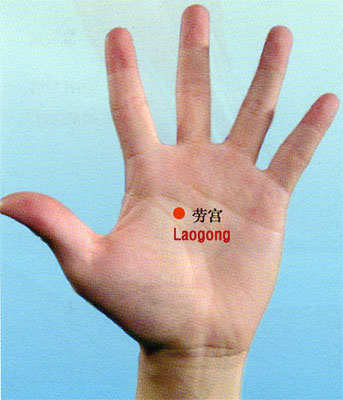
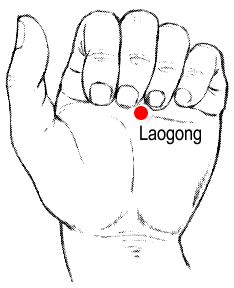
- At the center of the palm, in the depression between the tips of the 3rd and 4th fingers (middle and ring fingers, but closer to the ring finger) when the fingers are flexed.
- When the middle finger is flexed, its tip touches the transverse crease at the center of the palm (usually the intersection of the Heart Line and the Head Line in palmistry).
Underlying anatomical structures:
- Superficial layer: the palmar digital branches of the median nerve, providing sensory innervation.
- Deeper layer: involvement of the deep branch of the ulnar nerve, particularly fibers innervating the adductor pollicis muscle.
- Therefore, stimulation of Laogong may simultaneously affect both median and ulnar nerve pathways, influencing both sensory and motor functions.
Clinical significance:
This dual innervation explains why Laogong has a strong effect in regulating nervous activity, calming the Shen, clearing Heart heat, reviving consciousness, and also influencing circulation and hand muscle function.
Functions:
Clears Heart fire, calms the spirit, resolves damp-heat, clears heat from the chest and diaphragm, and directs Heart fire downward.
Indications:
- Palpitations, epilepsy, mental disorders;
- Cardiac pain;
- Pertussis (whooping cough);
- Stomatitis, oral ulcers, gingivitis, hiccup;
- Chronic palmar dermatitis, fungal infection of the hand (eczema), excessive sweating of the palms;
- Restlessness, agitation, nausea, retching, belching, acid regurgitation, flushed face, somnolence (combine with ST36).
Point combinations:
- Combine with ST36 (Zusanli): to treat Qi stagnation caused by heavy labor. (Heavy labor causes Qi stagnation because it depletes the Zheng Qi, so that Qi and Blood cannot be generated to meet the body’s needs; in addition, muscular tension, pain, and impaired Liver regulation contribute to the obstruction of Qi flow. This combination disperses Heart and Stomach fire, and subdues the upward surging of pathological heat Qi. [from General Discussion on Point Combinations]).
Needling method:
- Needling: Perpendicular insertion 0.3 – 0.5 cun.
- Moxibustion: Apply for 5 – 10 minutes (in cases of cold patterns).
Contraindications:
- Contraindicated in pregnancy, as it may cause miscarriage, premature delivery, or adversely affect the fetus (especially in the third month of pregnancy).
- Some sources state that moxibustion at PC-8 should be avoided, thus it should be applied with caution.