Meaning of the name:
When palpating this point, a pulsation can be felt (Chong = pulsation), and since the point is located on the dorsum of the foot, belonging to the Yang aspect, it is called Chongyang (Rushing Yang).
Other names (if any): Huigu, Huidong, Huyong, Huiyuan, Fuyang.
Characteristics:
Belongs to the Stomach channel of Foot Yangming.
The Yuan-Source point of the Stomach channel.
Location:
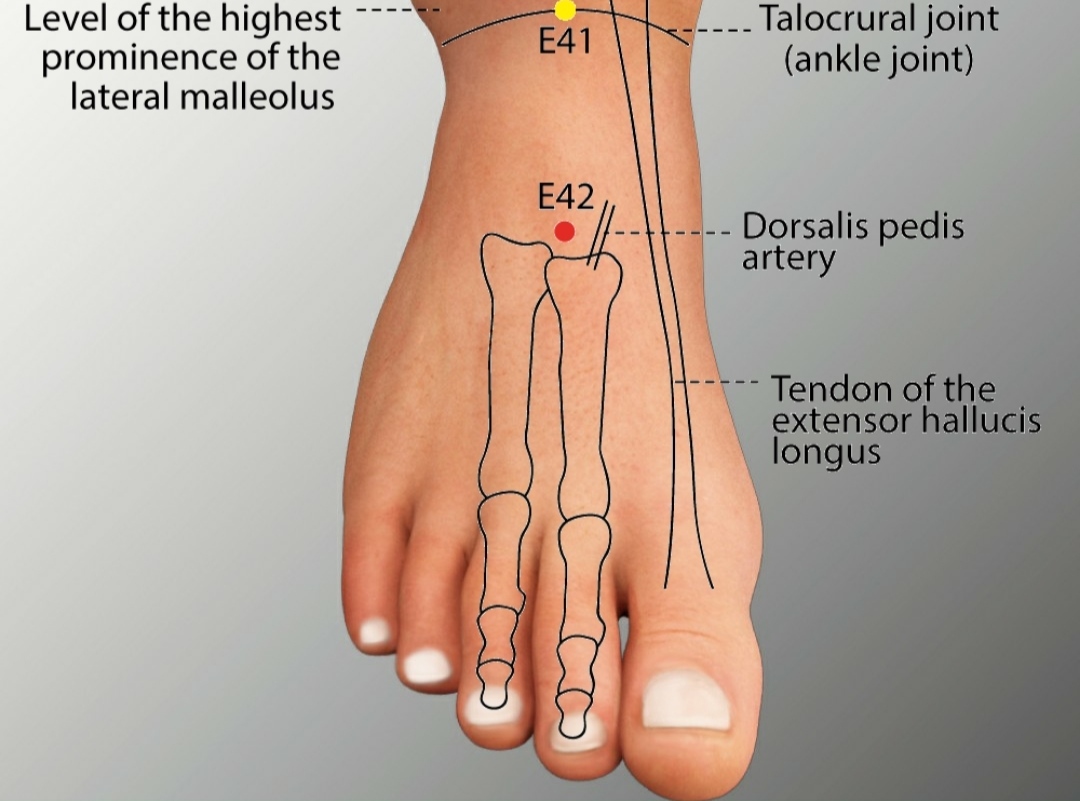
On the dorsum of the foot, in the depression between the 2nd and 3rd metatarsal bones, at the highest point of the dorsum.
Or 1.5 cun distal to Jiexi (ST-41), in line toward the toe direction, at the site of the palpable pulsation.
Underlying anatomical structures:
Superficial layer: skin and subcutaneous tissue containing branches of the dorsal venous arch and superficial capillary network.
Main vasculature: directly beneath the point lies the dorsalis pedis artery and the deep dorsal vein, a critical consideration requiring caution during needling.
Innervation: sensory supply from the superficial peroneal nerve; deeper distribution from the deep peroneal nerve, which accompanies the dorsalis pedis artery.
Adjacent structures: located on the dorsum of the foot between the tendon of extensor hallucis longus and the tendons of extensor digitorum longus.
Functions:
Transforms dampness, harmonizes the Stomach, and calms the Shen (mind).
In severe illness, if the pulsation at Chongyang can still be felt, it indicates that the Stomach Qi remains and the patient retains the capacity for recovery.
Indications:
Pain of the dorsum of the foot, paralysis of the lower limb;
Toothache, facial paralysis, gum pain, gingivitis;
Epilepsy, mental disorders.
Point combinations:
With BL-63, BL-58, KI-7, ST-36, SI-4 for weakness of the legs (Qianjin Fang).
With BL-65 for malaria invading the sinews (Qianjin Fang).
With ST-40 for manic running about (Qianjin Fang).
With ST-4 for hemiplegia and deviation of the mouth (Si Sheng Jing).
With BL-63, GB-12, BL-58, KI-7, ST-36 for atrophy, paralysis, or anesthesia of the legs (Si Sheng Jing).
With SI-3, HT-7 for mania (Zhen Jiu Da Cheng).
With ST-38, GB-39 for weakness and difficulty walking (Tian Xing Mi Gua).
With ST-43, KI-2 for swelling and congestion of the dorsum of the foot (Shanghai Acupuncture and Moxibustion).
With ST-38, GB-39 for weakness and difficulty in walking (Shanghai Acupuncture and Moxibustion).
With ST-41, ST-43, ST-45, ST-44 for carbuncles around the mouth (Wai Ke Li Lei).
Needling method:
Acupuncture: Perpendicular insertion 0.3 – 0.5 cun.
Moxibustion: 3 – 5 minutes.
Precautions:
Since the dorsalis pedis artery lies directly beneath this point, avoid deep or oblique insertion. Do not puncture the artery; palpate carefully before needling.